


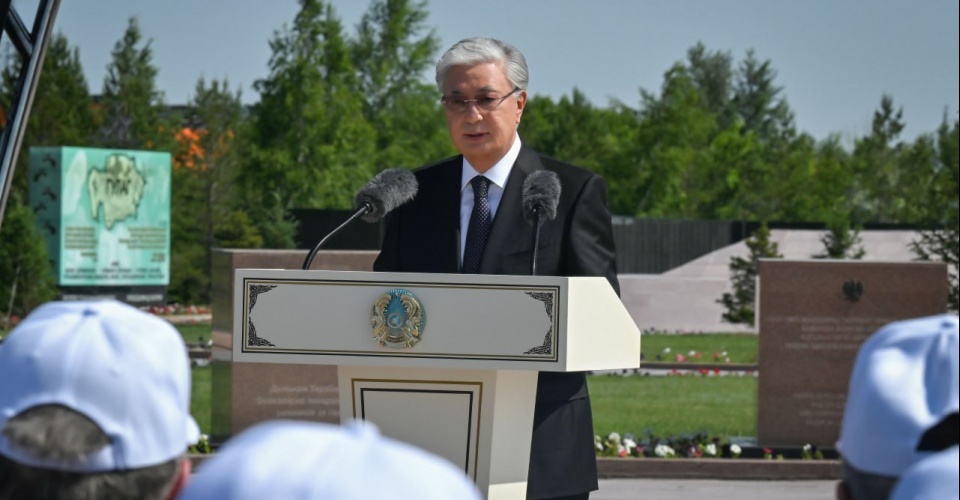
At a commemorative event dedicated to the Day of Remembrance for Victims of Political Repression and Famine, President Kasym-Jomart Tokayev emphasized the importance of remembering the tragic periods in Kazakhstan’s history and learning lessons from those dark times, according to the Adyrna national portal.
According to the President, significant efforts have been made in recent years to rehabilitate the victims of political repression. A state commission established five years ago has worked tirelessly for three years, leading to the political rehabilitation of more than 300,000 citizens. Additionally, the secrecy classification was lifted from over 2.5 million documents, resulting in the publication of a 72-volume collection and a 12-volume compilation related to the Alash movement figures.
“Uncovering the blank pages of our national history is a sacred duty to both our ancestors and future generations. The State Commission for the Full Rehabilitation of Victims of Political Repression was established five years ago. Over three years, many experts and scholars have worked diligently, thoroughly examining documents from state and institutional archives. As a result, more than 300,000 individuals who faced political persecution have been rehabilitated. Over 2.5 million documents have had their classified status removed. Based on the Commission’s research, a 72-volume collection was prepared. Cases related to the Alash Orda leaders during the repressions were compiled into 12 volumes. These include previously unpublished documents that are now being introduced into academic circulation for the first time,” the President stated.
A special archival center has been established, providing scientific access to over 700,000 previously classified documents. Tokayev stressed that these efforts are crucial steps in restoring historical justice.
The President reminded that the Kazakh people suffered the most from political repression and famine, noting that this tragedy was not unique to one nation but was shared across the entire Soviet space.
“More than 700,000 documents, previously secret criminal cases, have been handed over to this new center. This is an unprecedented undertaking in our country. To be frank, such extensive research has not been conducted in other countries. All this is the result of the dedicated efforts of our researchers. I express my heartfelt gratitude to all those who contributed to studying our national history, especially the members of the Commission. Their efforts will definitely be acknowledged and rewarded. Our scholars are now organizing and systematizing the gathered data. This is vital work for the future of our nation,” the President concluded.
He also called for history not to be used as a political tool, emphasizing that the nation’s strong unity, sense of responsibility, and humanism must remain key values for the future of Kazakhstan.








Other materials



Adyrna.kz ұлттық порталының маңызды ақпараттарына жазылу
Соңғы жаңалықтар туралы хабардар болыңыз