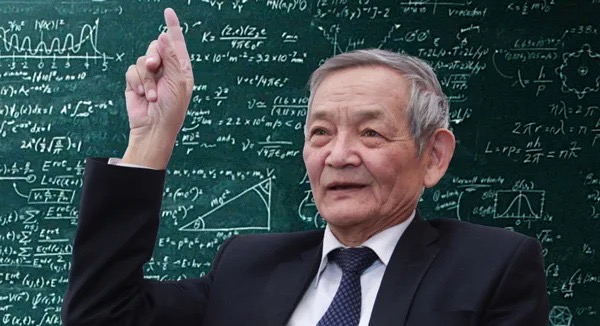
Dedicated to the intellectual journey of Mukhtarbay Otelbayuly Otelbayev, Academician of the National Academy of Sciences of the Republic of Kazakhstan under the President of the Republic of Kazakhstan. From the “Caravan of Science” series marking the 80th anniversary of the National Academy of Sciences of the Republic of Kazakhstan.
How can we discern the invisible order within a complex system? How can a formula tell us whether a physical problem has a solution, whether that solution is stable, and how much confidence we can place in the result of a calculation? For Academician Mukhtarbay Otelbayev, these questions became not merely the subject of a single study but the core of a lifelong research programme. The school he founded brought together spectral theory, functional analysis, differential operators, and boundary-value problems, opening new ways to investigate complex mathematical objects.
This year marks the 80th anniversary of the National Academy of Sciences of the Republic of Kazakhstan. Prepared for this milestone, the “Caravan of Science” series of feature articles introduces the wider public to the lives, scholarly legacies, and civic convictions of outstanding figures who made an immeasurable contribution to the formation and development of Kazakhstan’s science. The subject of this article is Mukhtarbay Otelbayuly Otelbayev - recipient of the State Prize of the Republic of Kazakhstan, Honoured Worker of Kazakhstan, Academician of the National Academy of Sciences, Doctor of Physical and Mathematical Sciences, and Professor.
His life demonstrates how a gifted village boy’s thirst for knowledge enabled him to overcome hard labour and adversity and rise to the highest levels of world mathematics. His sense of responsibility to his homeland and the lessons embodied in his life continue to inspire others.
A journey that began in Karakemer
Mukhtarbay Otelbayev was born on 3 October 1942 in the village of Karakemer, Korday District, Zhambyl Region. The hardship of the post-war years left its mark on his childhood. He began school later than his peers and, after the seventh grade, enrolled in a mechanical engineering technical college in Tokmak. Family circumstances, however, forced him to interrupt his studies and enter working life early, assisting a blacksmith and a tractor driver.
Arduous daily work did not diminish the young man’s passion for mathematics. While his peers rested, he would take up paper and pencil and solve problems. He strove to grasp the inner logic of a difficult formula and find his own route to a solution. The qualities that would define his scientific character - perseverance, independent thought, and a willingness to question established patterns - had begun to take shape in childhood.
After completing evening school, he entered Kyrgyz State University in Frunze in 1962. Two months later, however, he was called up for military service. While serving in a topographic unit in Turkmenistan from 1962 to 1965, he continued to study independently. After returning from the army, he passed several years’ examinations as an external candidate and resumed his education at an accelerated pace.
In 1966, Otelbayev passed the selection process organised by Lomonosov Moscow State University and transferred to its Faculty of Mechanics and Mathematics. After graduating in 1969, he remained there for postgraduate study. Under the supervision of the renowned mathematicians Boris Levitan and Alexander Kostyuchenko, he pursued his research and in 1972 defended his Candidate of Sciences dissertation on the spectrum of certain differential operators.
In 1978, at the age of only 36, he successfully defended his doctoral dissertation on estimates for the spectra of elliptic operators and related embedding theorems at Moscow State University. The defence took place before a dissertation council chaired by Andrey Kolmogorov. At the time, Kazakhstan had very few Doctor of Mathematical Sciences and Mukhtarbay Otelbayev’s emergence among them was a significant event for the country’s mathematical school.
Revealing invisible patterns
Mukhtarbay Otelbayev has conducted research in functional analysis, differential operators, spectral theory, function spaces, boundary-value problems, and nonlinear evolutionary equations. These fields may sound formidable to a reader without specialist training, but their underlying purpose is clear: to uncover the internal laws of a changing phenomenon and determine whether an equation has a solution, whether that solution is unique and stable, and how accurately it can be calculated.
The string of a musical instrument, for example, vibrates at a frequency determined by its length and tension. Complex systems likewise possess their own characteristic “tones” - their eigenvalues. Spectral theory investigates how those values are distributed and how they depend on the properties of a system. These concepts form part of the mathematical foundation of fields ranging from quantum mechanics to wave propagation.
Otelbayev’s innovation was to propose effective ways of studying a complex operator not only as a whole but also through its local properties. He devised a special construction that accurately captures the averaged effect of coefficients. In the scholarly literature, the term “Otelbayev function” became established in connection with this approach. A simple analogy helps explain it: a single average temperature cannot adequately describe the weather across a vast territory. Changes in each region must first be observed before an overall picture can be formed. Similarly, Otelbayev’s localisation method measures the behaviour of a complex mathematical object in each of its parts and uses those measurements to identify its general properties.
Using these methods, he studied the spectral properties of Schrödinger-type operators and obtained two-sided estimates for their eigenvalues. He refined the conditions under which the spectrum of an operator is discrete and showed that a universal asymptotic formula describing the spectrum does not exist in every case. His findings were later incorporated as dedicated chapters in major monographs on spectral theory.
In mathematics, it is not enough simply to say that “a solution exists.” Its bounds, accuracy, and robustness under change also matter. Otelbayev investigated embeddings and compactness in function spaces and proposed two-sided estimates for the norms of embedding operators, approximation numbers, and Kolmogorov widths. These results help determine how accurately a complex function can be approximated by simpler objects. Such estimates are vital in numerical computation and mathematical modelling because they define the limits within which a calculated result can be trusted.
The art of setting the right boundary
Knowing an equation alone is not enough to solve a differential equation: the initial or boundary conditions of the system must also be posed correctly. When calculating how heat spreads through a house, for instance, the result will not be realistic unless the outside temperature and the properties of the wall material are taken into account. An ill-posed problem may have no solution, may admit multiple solutions, or may be excessively sensitive to even slight variations in the initial data.
By developing a general theory of extensions and restrictions of operators, Mukhtarbay Otelbayev investigated which boundary conditions ensure that a problem is well posed. His school characterised well-posed boundary-value problems for such complex objects as Bitsadze–Samarskii, Cauchy–Riemann, ultrahyperbolic, and pseudoparabolic operators.
How can a solution be controlled in an infinite domain?
One of Mukhtarbay Otelbayev’s notable works is a 2016 Scopus-indexed paper, co-authored with Musakan Muratbekov, on singular differential operators of hyperbolic type in an unbounded domain. The paper proves the existence of the resolvent and the separability property for operators with growing coefficients.
To explain the result in accessible terms, imagine a wave travelling through an infinitely extended space. When the computational domain has no definite boundary, it becomes difficult to control the behaviour of the solution: its magnitude may grow without bound, or its individual components may become impossible to estimate. Proving the existence of the resolvent shows that the equation associated with the operator can be solved reliably for certain parameter values. The separability property makes it possible to estimate each component of the solution independently and determine its behaviour within the system as a whole. This theory is important for verifying the mathematical validity of models based on wave processes and hyperbolic equations.
Deriving the boundary condition from the equation itself
In 2016, Tynysbek Kalmenov and Mukhtarbay Otelbayev proposed a boundary criterion for integral operators. They determined the condition that must be imposed on the kernel of an integral operator in a bounded domain with a smooth boundary so that it satisfies the correct boundary condition for the corresponding differential equation. The result was demonstrated using the Sturm–Liouville equation, and a general form of well-posed boundary-value problems was obtained.
In simple terms, if an equation describes the internal law of a phenomenon, a boundary condition describes how that phenomenon interacts with its surroundings. Just as the outside temperature cannot be ignored when calculating heat inside a house, a mathematical solution loses its physical meaning when the boundary is defined incorrectly. The Kalmenov–Otelbayev criterion makes it possible to derive the boundary condition from the structure of the integral operator itself rather than selecting it by external conjecture.
This line of research continued in a 2020 study. Tynysbek Kalmenov, Mukhtarbay Otelbayev, and Gaukhar Arepova obtained Bitsadze–Samarskii boundary conditions for an elliptic-parabolic volume potential in a cylindrical domain. The result was derived from a spectral expansion of the Green’s function for the Holmgren problem. The model is distinctive because it combines elliptic behaviour in space with parabolic change over time or direction. The researchers gave a mathematical description of the boundary relation that uniquely determines the solution where these two characteristics meet.
Put simply, in a complex environment one part of a process may move towards equilibrium while another spreads over time. A standard boundary condition is insufficient for a system with such mixed behaviour. The study makes it possible to identify the “correct boundary” corresponding to the system’s internal structure.
A measure that prevents a set from “dispersing”
In 2019, Mukhtarbay Otelbayev, Yaudat Sultanaev, and Dinara Zhussupova obtained a criterion for the boundedness and compactness of a certain class of sets in function spaces on an infinite interval. In functional analysis, compactness is a crucial property that allows a convergent subsequence to be extracted from a sequence of solutions.
In an everyday analogy, boundedness means that objects do not “escape” beyond a specified region, while compactness guarantees that one can find a part that does not scatter chaotically but approaches a definite limit. Such criteria are needed in approximation methods and in proofs of the existence of solutions to differential and integral equations. Thus, before any particular formula is calculated, this work addresses a fundamental question: will the computational process converge and lead to a reliable solution?
This research line continues today. In 2025, Mukhtarbay Otelbayev and his colleagues Abdikhali Shynybekov and Karlygash Dosmagulova published a study on proper restrictions and extensions of operators. The paper examined the role of symmetry in preserving operator structure and the properties of approximation and convergence, applied the findings to a third-order nonlinear differential expression, and established a condition for the unique solvability of a Bitsadze–Samarskii-type problem. The study shows how the theoretical direction initiated by the academician decades ago continues to develop in connection with contemporary quantum theory, nuclear physics, and models of condensed matter.
Solving an equation with a singular point
Another long-standing area of Otelbayev’s research is the theory of generalised analytic functions founded by Ilya Vekua. Although ordinary analytic functions are well suited to describing many physical and geometric problems, they may be insufficient for complex systems with variable coefficients or singular points.
In 2021, Mukhtarbay Otelbayev and Alexander Soldatov published an important intermediate result in this field in a paper on integral representations of vector functions based on the parametrix of first-order elliptic systems. The authors introduced generalised integrals for variable-coefficient systems, evaluated both inside the domain and on its smooth boundary, and used them to characterise vector functions that are smooth on the closed domain. They also proved that the resulting representation has the Fredholm property in the relevant Banach spaces.
This can be understood as reconstructing the mathematical “portrait” of a complex object from data gathered in its interior and along its boundary. A parametrix is not the exact solution itself, but it is a fundamental construction that provides a systematic approximation to it. The Fredholm property, in turn, makes it possible to analyse solvability through a finite and manageable set of conditions. The study adapts the ideas of the classical Cauchy and Pompeiu integrals to vector systems with variable coefficients.
In 2025, Mukhtarbay Otelbayev, Bakytbek Koshanov, and Nazerke Oralbekova published a study on the theory of generalised Vekua analytic functions with a singular point. The authors determined the limits of the function spaces in which theorems on continuity and integral representation of solutions hold, and described the broadest space to which Vekua theory can be extended. They also proved the existence of solutions to an equation with a singular point and obtained two different integral representations of those solutions.
In simple terms, some models involve a phenomenon that changes abruptly near a particular point: the formula ceases to behave in the usual way, making the solution difficult to find. Rather than circumventing such a “difficult point,” the researchers showed in which space the solution is preserved and how it can be expressed. The result broadens the theoretical foundations of variable-coefficient systems and boundary-value problems.
Estimating the limits of nonlinear change
Most natural phenomena do not obey a simple law in which a change in one quantity is directly proportional to a change in another. Heat transfer, diffusion, waves in a medium, and complex time-dependent processes are described by nonlinear equations. Because exact solutions to such equations are difficult to find, it is important to estimate the magnitude, smoothness, and individual components of a solution.
In 2023, Nurbek Qakharman and Mukhtarbay Otelbayev proposed an alternative proof of the separability theorem for a certain class of nonlinear elliptic and parabolic equations. The advantage of the new approach is that it can be extended to entire systems of equations in non-reflexive function spaces. For a general audience, its significance can be explained as follows: a complex solution can be assessed not only as a single quantity but also by controlling its individual derivatives and components. This strengthens tests of a mathematical model’s stability and provides a firmer basis for numerical methods.
Navier–Stokes: a bold step and scientific responsibility
The Navier–Stokes equations are among the subjects that brought Otelbayev’s name to broad public attention. These equations describe the motion of water and air, fluid flow, and turbulence. Airflow around an aircraft wing, liquid moving through a pipe, and processes in the oceans and atmosphere are all connected with them.
Whether smooth solutions to the three-dimensional Navier-Stokes equations exist for all time, or whether the magnitude of a solution may become unbounded at some point and produce a mathematical “singularity,” has long been one of mathematics’ most difficult problems. The Clay Mathematics Institute included it among the seven Millennium Prize Problems and offered a reward of one million US dollars for a correct solution.
In 2013, Mukhtarbay Otelbayev published a paper on the existence of a strong solution to the Navier–Stokes equations. The work attracted considerable interest among international specialists and prompted extensive discussion. Questions were later raised about crucial steps in the proof, and the proposed result was not accepted as a complete and recognised solution to the Millennium Problem. This does not negate the significance of the scholar’s work. On the contrary, proposing a new approach to an exceptionally difficult problem and opening it to public scientific scrutiny demonstrates intellectual courage. That is the nature of science: every proof is tested, criticised, and refined, and even an attempt that does not yield a final solution may open the way to new questions and methods.
Otelbayev’s work on nonlinear evolutionary equations is also valuable for its investigation of criteria for the global solvability of Navier–Stokes-type systems and model examples for which no global strong solution has been found. His contribution to this field should therefore not be reduced to a single disputed paper; that study forms part of a coherent research programme pursued over many years.
From a formula to a school of thought
The legacy of a great scholar is measured by more than papers and theorems. One of Mukhtarbay Otelbayev’s most important achievements is the school of mathematics he established in Kazakhstan. For decades he lectured at universities, organised research seminars, and guided young scholars. Biographical records indicate that more than 70 Candidate of Sciences dissertations were defended under his supervision; at least ten of those students later became Doctors of Sciences, and several earned PhDs. Later feature articles report more than 80 students and 12 Doctors of Sciences trained under his guidance. Although the methods and periods of counting differ, one fact remains unchanged: the Otelbayev school represents one of the strongest traditions of scholarly continuity in Kazakhstan’s mathematics.
His students include recognised scholars in spectral theory, function spaces, differential operators, and inequalities: Ryskul Oinarov, Kairat Mynbayev, Musakan Muratbekov, Leila Kusainova, Kordan Ospanov, and others. They did more than repeat their mentor’s ideas; each developed an independent research direction and trained a new generation of scholars. This is the true strength of a scientific school: one person’s ideas continue and expand through the work of succeeding generations.
Otelbayev also played an active role in organising science. At the Institute of Mathematics and Mechanics of the Academy of Sciences of the Kazakh SSR, he progressed from research fellow to head of laboratory. He served as rector of Zhambyl Pedagogical Institute, founded and directed the Institute of Applied Mathematics in Karaganda, and headed a department at Kazakhstan’s Aerospace Agency. He contributed to education and research at Al-Farabi Kazakh National University, L. N. Gumilyov Eurasian National University, and the Kazakhstan Branch of Moscow State University. He helped establish the international Eurasian Mathematical Journal and served for many years as one of its editors-in-chief.
A scholar in the service of his country
In 1989, Mukhtarbay Otelbayev was elected a Corresponding Member of the Academy of Sciences of the Kazakh SSR, and in 2004 he became a Full Member of the National Academy of Sciences of the Republic of Kazakhstan. Also in 2004, he received the Economic Cooperation Organization Award in science and technology. In 2007, he was awarded the State Prize of the Republic of Kazakhstan in science and technology for the series of works “Spectral Theory and Its Applications.” It is described as the first State Prize in the history of independent Kazakhstan to be awarded for work in mathematics. In 2012, he received the title “Honoured Worker of Kazakhstan” and the Medal for Distinguished Labour.
It would be inaccurate to equate his findings with a ready-made industrial technology: Otelbayev is first and foremost a pure mathematician. Yet the long-term value of fundamental theory is immense. Spectral estimates help explain the stability of physical systems; boundary-value problems provide a basis for correctly modelling heat and wave propagation; and approximation theory makes it possible to assess the accuracy of numerical algorithms. These results increase the mathematical reliability of models in aerospace, energy, materials science, hydrodynamics, and computational technology. This is the essence of the scholar’s contribution to Kazakhstan: not a single finished device, but a culture of thought, a body of theoretical tools, and a school of professionals needed to create sophisticated technologies.
The five per cent problem in gas transportation
The theoretical tools of the Otelbayev school have also been applied to a specific industrial challenge. In 2024, Dinara Zhussupova, Mukhtarbay Otelbayev, and Saule Burgimbayeva modelled the operation of a gas compressor station and proposed a method for reducing fuel consumption. As gas travels through a main pipeline, friction against the walls causes it to lose pressure and velocity. Compressor stations that restore the pressure may consume approximately five per cent of the transported gas for their own operation.
The researchers developed a mathematical model that makes it possible to control the rotational speed of compressor units and the position of valves. Calculations revealed technically unjustified fuel consumption at the station under study and provided a basis for recommendations to reduce it. Because the station lacked instruments for directly measuring the mass flow rate of gas, widely used automatic control methods could not be applied. The proposed model is therefore valuable as an alternative tool that helps dispatch engineers maintain safe operating conditions and reduce excess gas consumption using the data available to them.
This study clearly demonstrates the economic significance of fundamental mathematics. A formula cannot do the work of a pipeline, but it can support sound decisions and provide a scientific foundation for conserving energy and natural resources.
In the early years of independence, many specialists left the country. Mukhtarbay Otelbayev remained and worked to preserve continuity in Kazakhstan’s scientific tradition. He has consistently raised questions concerning the native language, national education, and young people’s mathematical literacy. In his view, science and national consciousness do not stand in opposition. The academician believes that recognition at the global level requires one to remain connected to one’s national foundations.
The character that leads to the summit
Mukhtarbay Otelbayev’s life shows that success in science did not come easily. Starting school late, undertaking hard physical labour in the village, studying independently during military service, passing several years’ examinations at once, and striving for recognition in Moscow’s demanding academic environment the did not retreat before any of these trials. His inexhaustible thirst for knowledge kept him moving forward and true to his chosen path.
In mathematics, he did not confine himself to applying a ready-made formula; he asked when it was valid and where its limitations lay. Alongside the search for universal answers, he showed that proving the non-existence of a universal formula can itself be scientifically important. Before seeking a solution to a boundary-value problem, he taught others to determine whether the problem had been posed correctly. This is not merely a mathematical method; it is a culture of thought.
If Mukhtarbay Otelbayev’s equations seek to reveal the invisible order of nature, his life shows how talent, sustained by hard work, can attain remarkable heights.
The village boy from Karakemer who once bent over pencil and paper later ventured boldly into some of the most difficult problems in world mathematics. The methods he developed, the school he established, and the students he trained have become part of the intellectual wealth of Kazakhstan’s science. In the language of mathematics, the true summit lies not only in solving a complex formula, but also in sustaining a scientific tradition that turns knowledge into a public good. The distinguished life of Mukhtarbay Otelbayev bears eloquent witness to this truth.
Professor
Gulmira Sultanbayeva