Artificial intelligence is changing more than technology. It is reshaping management, education and public communication. Universities therefore need to create learning environments in which students can apply theoretical knowledge to real cases and engage directly with international experts.
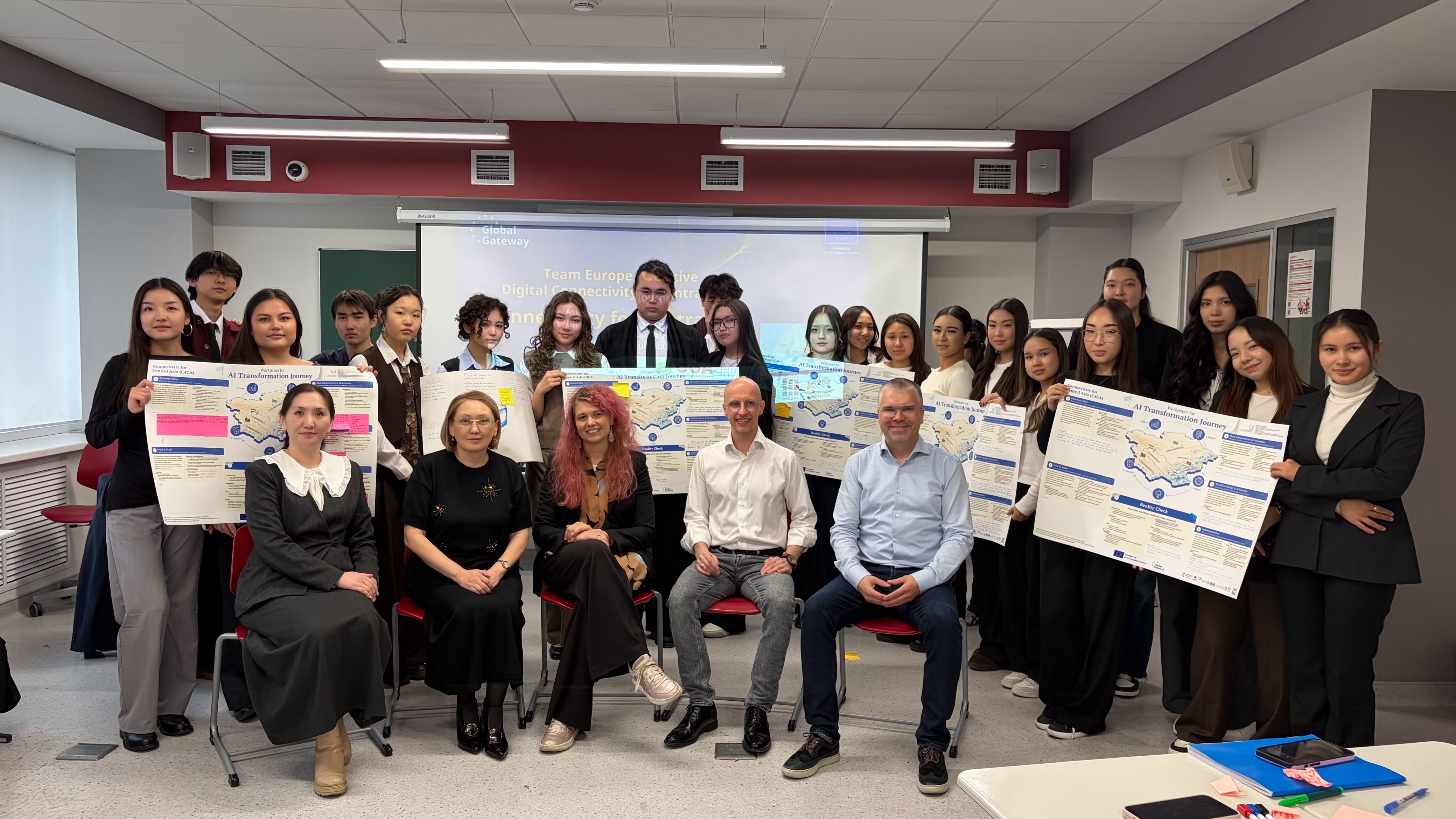
On 13 November 2026, Narxoz University hosted the AI Transformation Journey workshop as part of the European Union’s international Connectivity for Central Asia (C4CA) project. The event brought together students, faculty members and experts from Finland.
The workshop was organised for second-year students enrolled in the English-medium Political Mass Communications educational programme within the World Political Processes course. Its format encouraged students to approach digital transformation as a technological, managerial and communication challenge.
The Finnish delegation included Dr Asko Mononen, Manager of Research and Development and Head of the Human-Centric Technology research group at Laurea University of Applied Sciences; Oskari Vesterinen, Senior Lecturer at Laurea and a specialist in management, leadership and organisational development; and Linda-Lotta Luhtala, Specialist and Project Manager at the HAUS Finnish Institute of Public Management and one of the C4CA project leads from HAUS.
Their areas of expertise created a multidisciplinary discussion covering human-centred artificial intelligence, organisational readiness for change, digital competence development, transformation project management and digital inclusion.
The practical component of the workshop centred on teamwork. The students formed groups and selected cases involving Kaspi.kz, Narxoz University, Air Astana, and Testcenter. Each team analysed the selected organisation and developed proposals for adopting artificial intelligence, digitalising processes and improving organisational performance.
The students identified processes requiring transformation, considered suitable technological solutions and assessed the potential effects on employees, customers and society. The exercise demonstrated that successful AI adoption depends on more than the quality of technology. Organisations also need clear objectives, ethical principles, readiness for change and carefully planned communication.
Student perspectives
Damir Nasyrov: «The AI Transformation Journey workshop was highly engaging and informative. I particularly enjoyed working on our group case about Kaspi.kz and its new AI feature, Kasper, as we explored how artificial intelligence could be integrated into everyday services. Hearing the Finnish experts’ views and practical experience was especially valuable: it gave us new knowledge and helped us see AI transformation from a different perspective.»
Elnara Avakri: «The workshop was a valuable and engaging experience for me. Rather than discussing artificial intelligence only in theory, we worked on a practical case, learned to examine a problem from different perspectives and searched for solutions. The Finnish experts helped us understand that digital transformation requires attention not only to AI’s technological capabilities, but also to its impact on society, government and everyday life. After the workshop, I began reflecting on questions I had never considered before.»
Aizhan Kudaibergenova: «We really enjoyed the workshop because we worked on real cases, shared ideas and considered how AI could help solve everyday challenges. It was also interesting to hear the Finnish experts’ perspectives and learn from their experience. Most importantly, the workshop inspired us to think beyond the classroom and develop ideas for something new that we could introduce at our own university.»
The working group from the School of Law and Public Policy included Professor Ainur Kussainova and Associate Professor Madi Kenzhaliyev. The workshop formed part of the World Political Processes course taught by Assistant Professor Zhanar Abdikadyrova.
Connectivity for Central Asia is being implemented from 2025 to 2028 under the Global Gateway strategy and the Team Europe initiative. Covering Kazakhstan, Kyrgyzstan, Tajikistan, Turkmenistan and Uzbekistan, the project aims to support secure, accessible and inclusive digital infrastructure and services across Central Asia.
Narxoz University’s engagement in international initiatives of this kind broadens the learning environment and gives students direct access to current global debates. The Political Mass Communications programme connects the study of political processes, media and strategic communication with the practical analysis of technological and social change.
This approach prepares students not merely to observe digital transformation but to understand its public implications, participate in decision-making and develop responsible solutions for business, government and society.
Zhanar Abdikadyrova, Ainur Kussainova